Kuala Kangsar
Kuala Kangsar
A royal city in Perak overlooked by mainstream tourism circuits, Kuala Kangsar reveals palatial estates, a golden mosque, and colonial heritage in a peaceful setting.
Situated at the confluence of the Kangsar and Perak rivers, Kuala Kangsar is the royal city of the state of Perak. This small town, often absent from standard tourist itineraries, distinguishes itself through its historical heritage, palaces, and remarkable monuments. You will discover here a serene atmosphere and a collection of sites connected to the Malay monarchy and colonial history.
History
Kuala Kangsar served as the capital of Perak until 1876, before being succeeded by Taiping, then Ipoh in 1937. The city functioned as the administrative seat of the first British Resident of the Malay Peninsula, James W. W. Birch, from October 1874 until his assassination in November 1875.
Its name is believed to derive from the term Kuala Kurang-Sa, literally meaning "ninety-nine," generally interpreted as "the 99th tributary flowing into the Perak River."
Sultan Yusuf Sharifuddin Mudzaffar Shah, who reigned from 1877 to 1887, commissioned the construction of the first royal palace on the riverbank. Repeated flooding, including the great inundation of 1926, eventually forced authorities to relocate the royal residence to higher ground.
In 1897, the city hosted the first Conference of Sovereigns of the Federated Malay States. That same year witnessed the construction of the Victoria Bridge. Kuala Kangsar is also the location where Malaysia's first rubber tree was planted, thanks to British botanist Henry Nicholas Ridley, who helped establish the country as the world's leading rubber producer.
What to See in Kuala Kangsar?
The Ubudiah Mosque
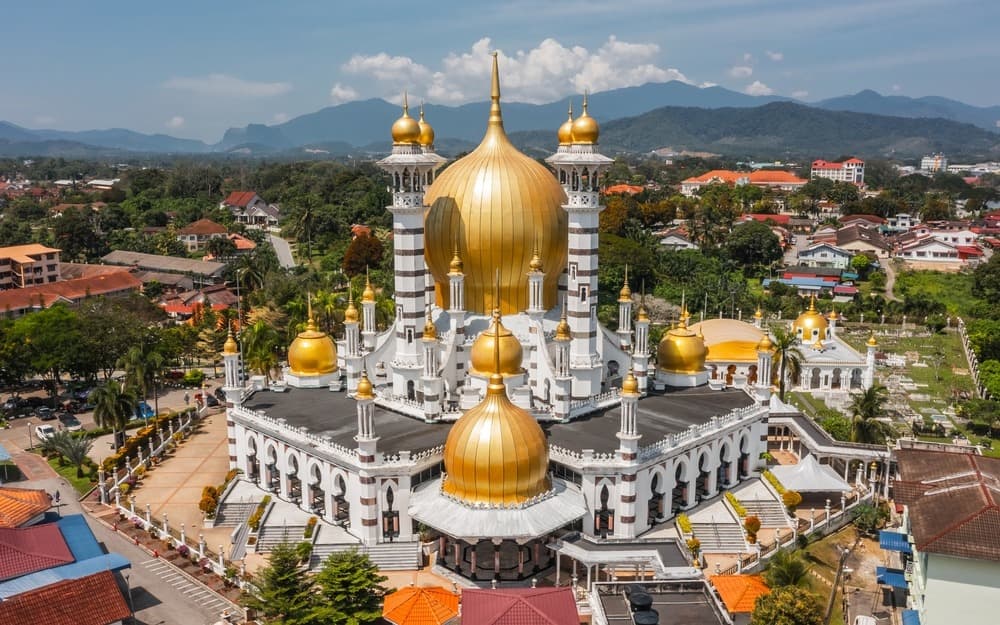
The Ubudiah Mosque is arguably the city's most iconic monument. Its gilded dome and minarets, framed by coconut palms, create a striking tableau. It was designed by government architect Arthur Benison Hubback.
Erected on the orders of Sultan Idris Murshidul Adzam Shah, construction of this edifice began in 1913 and was completed in 1917. It experienced an unexpected episode: two royal elephants, while fighting, damaged marble imported from Italy, which delayed the work.
Istana Kenangan
Istana Kenangan is the former royal residence, now converted into the Royal Museum of Perak. With its finely carved sculptures adorning the walls and roof, in a striking contrast of yellow and white, the building exemplifies traditional Malay architecture perfectly. It was constructed without architectural plans and without a single nail.
Istana Iskandariah
Istana Iskandariah is the official residence of the Sultan of Perak since its completion in 1933. Situated on the heights of the city, it faces the sunrise and the river.
Its architecture draws inspiration from Western Asian traditions, featuring an onion-shaped dome and characteristic minarets. Although closed to the public, a road circles the palace and reveals its majestic façades.
The Sultan Azlan Shah Gallery
The Sultan Azlan Shah Gallery chronicles the life of Sultan Azlan Shah through a collection of personal belongings: ceremonial attire, swords, collections of coins, banknotes, and timepieces.
Visitors also discover his journey, from his academic formation to his royal duties, as well as his passion for hockey.
The Victoria Bridge
Constructed between 1897 and 1900, the Victoria Bridge crossed the Perak River at Karai. It was inaugurated by Sultan Idris and named in tribute to Queen Victoria.
This single-track railway bridge has been out of service since 2002. Its aesthetic evokes the colonial era.
The Pavilion Tower
Erected in 1930 on the orders of Sultan Iskandar Shah, the Pavilion Tower is a three-level structure situated opposite Malay College. Royal families once used it to attend polo matches. Now restored, it is part of a public park. It is sometimes nicknamed the "Pagoda of Malaysia."
The Iskandariah Bridge
The Iskandariah Bridge, also called the Sultan Iskandar Bridge, is the country's longest steel arch bridge (308 meters long and 10.2 meters wide). Constructed in 1932 by Messrs James Craig Ltd, it was inaugurated by Sultan Iskandar of Perak.
The city is served by regular buses from Ipoh and Taiping, as well as the railway line connecting Kuala Lumpur to Butterworth. Highway E1 and Federal Road 76 provide road access.
When to Visit Kuala Kangsar?
The period from December to March corresponds to the driest season on the west coast of Malaysia, making it the best time to explore the city.
Want to discover this destination?
Our local advisors design your tailor-made trip.