Bako National Park
Bako National Park
Just 40 km from Kuching, Bako National Park brings together proboscis monkeys, seven ecosystems, and a coastline carved by erosion across 27 km² of Borneo jungle.
Bako National Park sits at the tip of the Muara Tebas peninsula in Sarawak State on the island of Borneo. Spanning roughly 27 km², it encompasses seven distinct ecosystems, abundant endemic wildlife, and a coastline sculpted by erosion. It ranks among the most sought-after nature outings from Kuching.
Why visit Bako National Park
Bako concentrates the essence of Borneo's biodiversity within a compact territory. The park ranks among the world's finest spots for observing the proboscis monkey, a Borneo endemic primate with roughly 150 individuals inhabiting the area. Add to this over 150 bird species, carnivorous plants, and two of the four horseshoe crab species existing on the planet—arthropods whose lineage reaches back 450 million years.
Access is exclusively by boat from Kampung Bako's pier, reinforcing the sense of isolation once you arrive. The trails, well-marked and varying in difficulty, allow you to tailor your visit according to your fitness level.
A touch of history
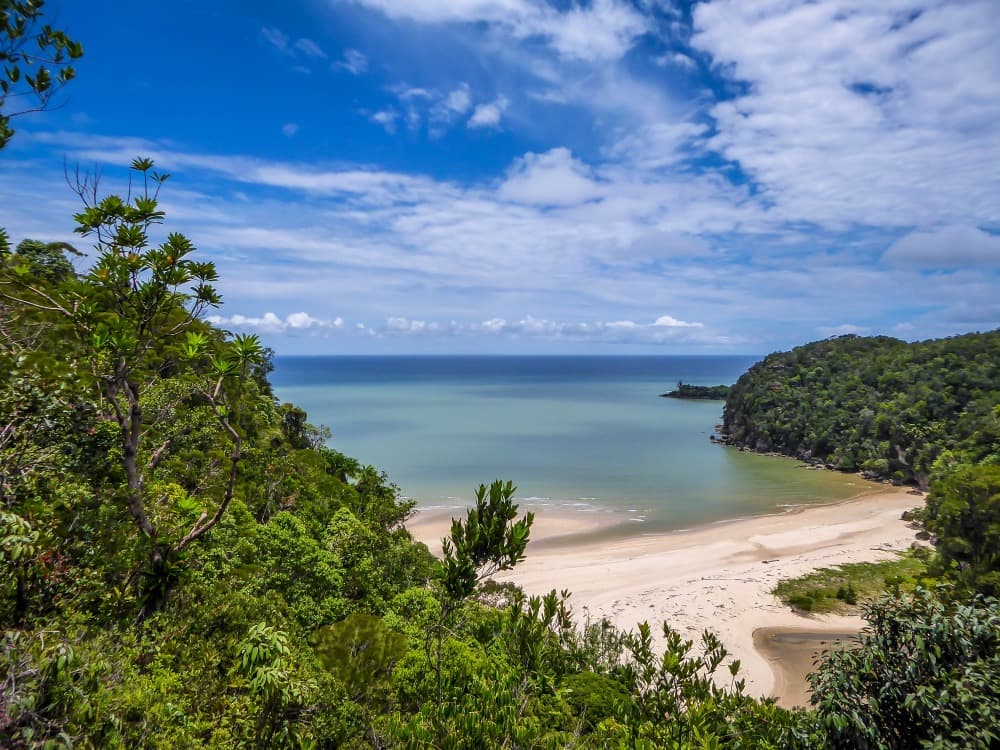
Established in 1957, Bako is Sarawak's oldest national park. Its landscape results from millions of years of erosion: sheer cliffs, rocky promontories, sea arches, and sandy bays line the shoreline in succession. Ferruginous deposits create colorful patterns on the rock in places.
Until 2024, the park was home to a rocky spur shaped like a cobra's head, which became its signature over the decades. This formation collapsed that year, marking the disappearance of an iconic landmark in Bako photographs.
What to see and do at Bako
Spot proboscis monkeys and other primates
Proboscis monkeys are most visible at dawn and dusk, near the pier and on adjacent beaches. Other primates inhabit the park:
- long-tailed macaques, omnipresent around accommodations;
- crested leaf monkeys, recognizable by their distinctive crest;
- silvered leaf monkeys, with metallic sheen.
At night, flying lemurs and flying shrews take over, while bearded pigs forage the forest floor.
Birdwatching
Over 150 species frequent the various habitats. Between September and March, migratory birds enhance diversity: Eurasian curlews, sandpipers, pipits. In the mangroves, Macklot's sunbird and mangrove pitta are common. On rocky beaches, the red-footed booby plunges vertically to fish.
See carnivorous plants and botanical mosaics
Bako brings together seven ecosystems across a limited territory: coastal mangrove, cliff vegetation, kerangas (heathland forest), padang (grasslands), swamp forests, and beach vegetation. Pitcher plants develop their trap-urns filled with digestive fluid, while sundews capture prey using their sticky leaves.
Hike the trails
Sixteen marked trails crisscross the park. Upon arrival, the visitor centre provides a map showing open routes. Two short trails offer a good overview:
- Telok Delima: 1 km round-trip, recommended for proboscis monkey spotting;
- Telok Pandan Kecil: 2.6 km round-trip, leading to an isolated beach.
The paths wind between roots and rocks, equipped in places with wooden boardwalks. For safety reasons, report your itinerary to the visitor centre before departing.
Join a night walk
A guided evening outing after dark lets you spot snakes, tree frogs, giant insects, and fireflies near the mangrove. The rate remains modest and a naturalist's accompaniment maximizes sightings.
When to visit
The equatorial climate ensures high temperatures year-round. The dry season, from March to October, offers the best hiking conditions. The period from September to March coincides with migratory bird passage, offset by more frequent rain. For wildlife in general, early morning and late afternoon remain the most productive times.
Practical information
Park entry is purchased at the headquarters visitor centre and includes a conservation tax. Plan for roughly 25 ringgits per person, preferably paid in cash. The guided night walk incurs a modest additional fee.
The park offers several accommodation types: bungalows, rooms, and camping spots. Facilities are basic but functional, some with air conditioning. A cafeteria serves affordable meals. Book several weeks in advance, particularly during high season.
Recommended gear: grip-soled hiking shoes, lightweight clothing, hat, sunscreen, insect repellent, binoculars or telephoto lens, headlamp for night walks, and plenty of water.
How to get there
Bako lies roughly 40 km north of Kuching. Bus #1 serves Kampung Bako's pier from downtown with regular daytime departures (verify current schedules on-site). From the pier, allow roughly twenty minutes of navigation to reach the park entrance. The last boats depart mid-afternoon: for a day visit, start early morning.
Nearby attractions
Once you've explored Bako, Sarawak and the rest of Malaisie offer other nature experiences. Batang Ai National Park, further inland, allows you to approach Iban culture and primary forests. On the peninsula, the Mossy Forest of the Cameron Highlands and Penang Hill offer very different highland tropical ecosystems. The Batu Caves near Kuala Lumpur complete an itinerary combining nature and heritage.
Frequently asked questions
Frequently asked questions
A day visit is possible but limited, as the last boats depart mid-afternoon. To observe proboscis monkeys and nocturnal wildlife, plan for one to two nights on-site.
The park manages bungalows, rooms, and camping spots. Accommodations are basic but functional, some air-conditioned. Booking is advised several weeks in advance, particularly during high season.
Chances are high with roughly 150 individuals in the park, but no sighting is guaranteed. The most favorable times are early morning and late afternoon near beaches and the pier.
Yes, provided you choose short trails like Telok Delima. The humid heat and some slippery passages require caution with young children.
Plan your Malaisie journey
Bako National Park naturally fits into a Sarawak itinerary combining Iban culture, endemic wildlife, and coastline. To build a custom itinerary covering Kuching and surroundings, consult our suggestions for voyages en Malaisie.
Interested in this visit?
We can include it in your personalised itinerary.