Padang Mosque
Padang Mosque
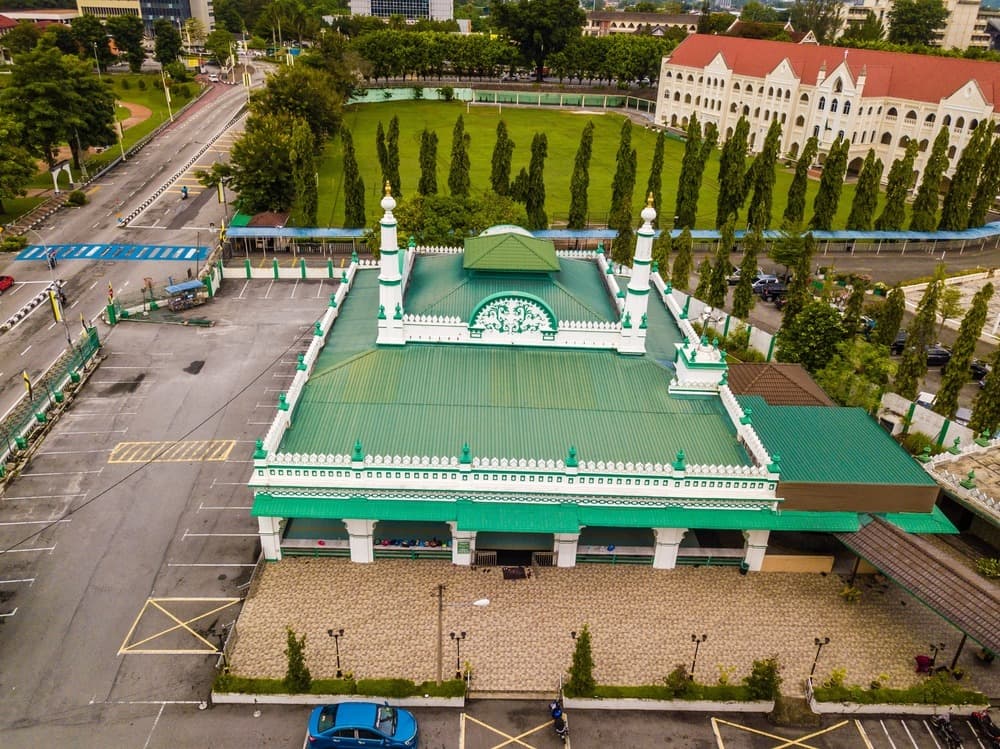
Built in 1908 for Ipoh's Tamil Muslim community, Padang Mosque impresses with its striking Mughal architecture, distinctive green and white façade and fortress-like appearance.
Padang Mosque stands at the heart of Ipoh, capital of Perak State, and remains one of the rare testimonies to the Tamil Muslim community of Hanafi rite in Malaysia. Built in 1908 in a pronounced Mughal style, it is instantly recognisable by its distinctive green and white façade and its fortress-like character.
Why visit Padang Mosque
- A rare Mughal architecture in Malaysia, inspired by the fortresses of northern India
- A building founded by and for Ipoh's Tamil Muslim community, still active today
- Sermons delivered in Tamil, a marker of cultural identity preserved for over a century
- A free-access historical site, easily integrated into a walking tour of central Ipoh
History of the mosque
The mosque was built in 1908 for Tamil Muslims of the Hanafi rite settled in Perak. Its foundation is linked to a businessman from the community, Shaik Adam, owner of the Kinta Aerated Water Works, a prosperous mineral water factory of the era.
Arriving in Perak in the late 1880s, Shaik Adam began as a clerk with a tailor before establishing his own business in Ipoh. His rise typifies that of many Tamil migrants who came to the region during the British colonial period, drawn by the thriving tin mines of the Kinta Valley.
The total construction cost was approximately 25,000 dollars, with 20,000 directly funded by Shaik Adam. The government of the time and other donors covered the balance. The mosque was inaugurated in April 1908 at a ceremony bringing together the city's Tamil Muslim community.
What to see on site
The building was constructed by Indian labourers in a Mughal architectural style, inspired by the great fortresses of northern India. Its square form, roofline balustrades and scalloped arches give it the appearance of a small fort rather than a classical Southeast Asian mosque.
The green and white façade unifies the composition, punctuated by large square-framed windows that flood the prayer hall with abundant natural light.
The interior
The prayer space is organised around the mihrab, a niche oriented towards Mecca. To its right, a wooden minbar welcomes the imam during sermons, still delivered in Tamil. To the left of the mihrab, a wall clock indicates prayer times; nearby, a table and cabinet display commemorative plaques and objects accumulated by the mosque over the decades.
The ablution area
At the rear of the building, a dedicated ablution space has been arranged with semi-circular walls fitted with taps, where the faithful purify themselves before prayer. The layout remains faithful to the original design from the early twentieth century.
Practical information
- Address : Jalan S.P. Seenivasagam, Ipoh, Perak State
- Access : on foot from Ipoh's historic centre; by taxi or Grab from the railway station
- Fee : free entry, donations welcome
- Visit : allow 20 to 30 minutes on site; it is best to avoid prayer times if you are not Muslim
- Dress code : shoulders and legs covered; headscarf recommended for women; shoes to be removed before entering
- Photography : exteriors without restriction, interior by permission from the staff on site
Nearby
Padang Mosque is part of a wider visit to the city of Ipoh, whose colonial heritage, Chinese temples and street food deserve a full day. Those interested in cave sites may continue to the Kek Lok Tong temple, set within a limestone cave in the Kinta Valley.
Further south, near Kuala Lumpur, Batu Caves and the Menara Kuala Lumpur tower round out an itinerary focused on Malaysia's religious and architectural heritage.
Plan your visit
Padang Mosque naturally fits into a cultural circuit through Peninsular Malaysia combining Kuala Lumpur, Ipoh and Penang. To build a bespoke itinerary including this site and other heritage destinations in Perak, consult our Malaysia trips.
Interested in this visit?
We can include it in your personalised itinerary.