Birch Memorial Clock Tower
Birch Memorial Clock Tower
Erected in 1909 in Ipoh, the Birch memorial tower recounts a pivotal chapter of British colonisation in Perak through its Doulton panels.
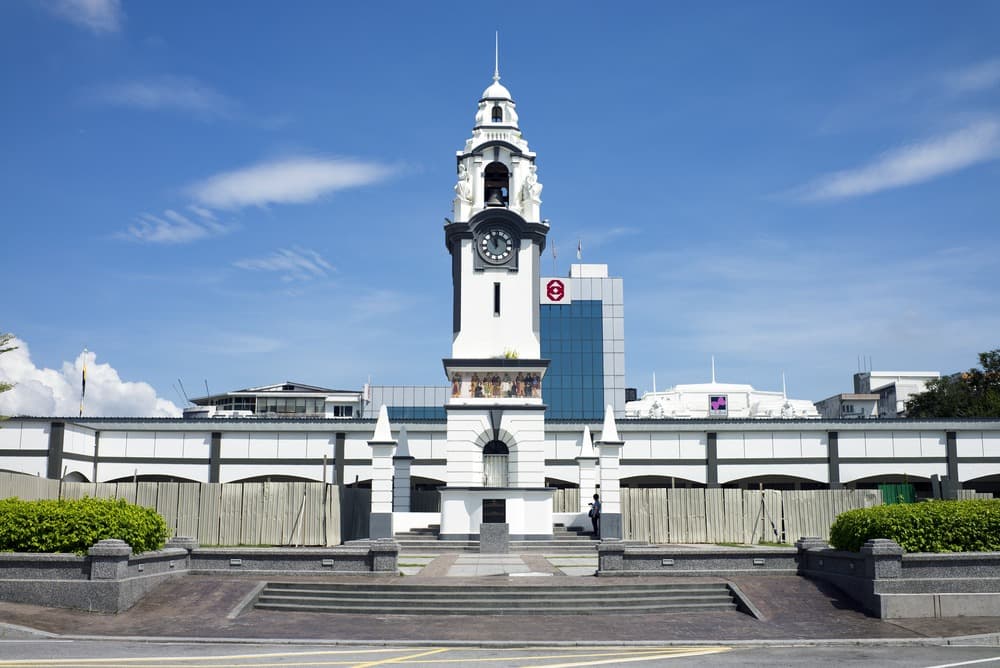
In the heart of the colonial quarter of Ipoh, capital of Perak State, a white square-based structure stands facing the State Mosque: the Birch Memorial Clock Tower. Built in tribute to a British administrator assassinated in 1875, the monument today embodies a complex chapter of Malaysian history, between colonial narrative and Malay memory.
Why visit the Birch Clock Tower
The tower holds interest on several counts. From an architectural perspective, it stands as a well-preserved witness to early 20th-century British colonial urbanism, complete with decorative ceramic panels signed by Doulton. Historically, it compresses two opposing narratives into a single location: that of the British Empire and that of Malay resistance. Finally, its central position, just a few minutes' walk from Ipoh's Old Town and its cafés, makes it a logical stop on a tour of the heritage centre.
A tower born from colonial assassination
Construction of the tower began in 1908 and was completed the following year. Sir John Anderson, British High Commissioner for the Federated Malay States, presided over the inauguration ceremony.
The structure was erected in memory of James Wheeler Woodford Birch, the first British Resident of Perak, appointed in 1874. Birch undertook to reform the state's administration, imposing a structured legal system, centralised taxation, and infrastructure designed to facilitate tin mine exploitation.
His mandate was brief. In 1875, Birch was assassinated at Pasir Salak by Dato Maharaja Lela. The event triggered the Perak War, at the end of which the British substantially reinforced their grip on the state and its tin deposits.
A monument with dual readings
For the British administration, Birch embodied the Empire's servant who died in the line of duty. On the Malay side, his actions were perceived quite differently: the imposition of reforms without consultation with sultans and traditional chiefs fuelled deep resentment, and Dato Maharaja Lela is today regarded in Malaysia as a national hero, studied as such in school curricula.
The paradox is evident in the nomenclature of the square itself. The streets bordering it, Jalan Dato Maharaja Lela to the north and Jalan Dato Sagor to the south, bear the names of the men executed for Birch's murder. The colonial monument and Malay memory thus stand side by side just metres apart.
What to see on the tower
The structure, square in form, is built in brick and concrete, with a pale facing. A niche set into the façade originally housed a bronze bust of Birch.
At the four upper corners, four statues personify the cardinal virtues of European tradition: prudence, justice, strength, and temperance.
The most remarkable element remains the frieze of four ceramic wall panels, designed by Messrs. Doulton and Co. in London. They trace a history of civilisation through forty-four figures, distributed as follows:
- North panel: Stone and Iron Ages, then Egyptians, Assyrians, and Persians.
- West panel: Moses and David, Confucius, Buddha, Lao Tzu, Plato, Alexander the Great, Augustus.
- South panel: Constantine, Saint Clare of Assisi, Saint Thomas Aquinas, Galileo, Michelangelo, Christopher Columbus, Luther, Shakespeare.
- East panel: Newton, Watt, Beethoven, Darwin, Edison, Florence Nightingale.
The clock mechanism comprises a main bell and four smaller bells, supplied by Messrs. Gillet and Johnson of Croydon. The carillon continues to punctuate the life of the quarter.
Practical information
- Location: Kinta district, in the heart of Ipoh, facing the State Mosque (Masjid Negeri) and near City Hall.
- Access: the tower stands on a public square open at all times; visits are exterior and free of charge.
- Duration: allow 15 to 30 minutes to walk around all four panels and study the iconography in detail.
- When to visit: late afternoon light enhances the whiteness of the façade; morning remains the quietest time for traffic.
- Good to know: the square is bordered by busy thoroughfares; it's best to cross at designated passages.
What to see nearby
The tower is part of a dense heritage ensemble. Within short walking distance:
- The State Mosque of Perak, just across the way, whose modern silhouette contrasts with the colonial monument.
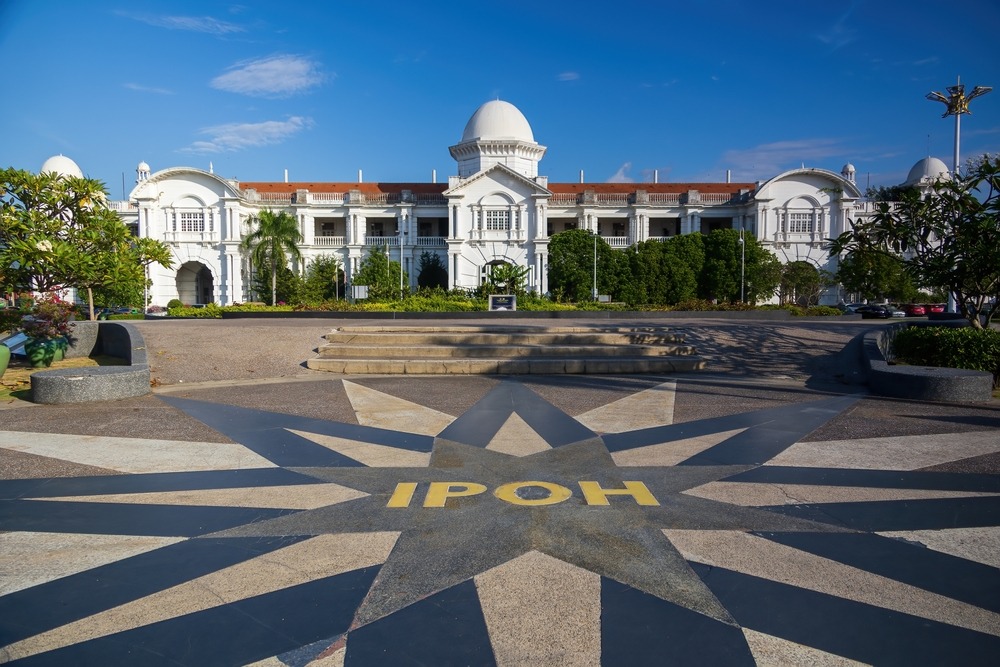
- City Hall and Ipoh's railway station, two emblematic colonial buildings in the quarter.
- Ipoh Old Town, known for its shophouses, wall murals, and traditional kopitiams.
To extend your visit beyond the centre, several major sites are accessible in the region: Kek Lok Tong temple, set in a limestone cave on the outskirts of Ipoh, makes an excellent complement to a day devoted to Perak. Further afield, Batu Caves near Kuala Lumpur or Kek Lok Si temple in Penang rank among the classic stops on a Peninsular Malaysia circuit. For a fuller discovery of Ipoh and its surroundings, consult our dedicated guide.
Frequently asked questions
Frequently asked questions
First British Resident of Perak, appointed in 1874. Tasked with overseeing the sultan, he imposed administrative and fiscal reforms deemed brutal by Malay chiefs. He was assassinated in 1875 at Pasir Salak by Dato Maharaja Lela, which triggered the Perak War.
The four ceramic panels, created by the Doulton house in London, trace a history of civilisation through forty-four figures: prehistory and Oriental antiquities to the north, Mediterranean and Asian cultures to the west, Middle Ages and Renaissance to the south, and modern science and arts on the final panel.
In Kinta district, at the centre of Ipoh, on a square facing the State Mosque and near City Hall. It is framed by Jalan Dato Maharaja Lela to the north and Jalan Dato Sagor to the south.
No. The tower can be viewed from the public square surrounding it. Visits are exterior, free, and available at all times.
Include Birch's tower in your trip
The Birch Clock Tower fits naturally into an itinerary combining Kuala Lumpur, Ipoh, and the heights of the Cameron Highlands. To build a bespoke journey blending colonial heritage, natural sites, and historic towns, consult our Malaysia travel suggestions.
Interested in this visit?
We can include it in your personalised itinerary.