Endau-Rompin National Park
Endau-Rompin National Park
870 km² of tropical rainforest spanning Pahang and Johor: tigers, elephants, 120-meter waterfalls and demanding trails through one of Malaysia's ancient mountain ranges.
Endau-Rompin National Park protects 870 km² of humid tropical rainforest straddling the Malaysian states of Pahang and Johor. Malaysia's second-largest peninsular national park after Taman Negara, it takes its name from the two rivers that flow through it, the Endau and the Rompin, and ranks among the region's ancient forest massifs.
Why visit Endau-Rompin Park?
Endau-Rompin remains one of peninsular Malaysia's least-visited parks, a stark contrast to the tourist flow converging on Taman Negara. It appeals to travelers seeking serious forest immersion: demanding trails, jungle camping, secluded waterfalls and abundant wildlife. The park concentrates several emblematic species: Malayan tiger, Asian elephant, Malayan tapir, clouded leopard, and Malayan sun bear. Its rock formations, dating back approximately 248 million years (Permian-Triassic), represent a recognized geological attraction, and the site gained ASEAN Heritage Park status in 2022.
Park history
Scientific documentation of the region dates back to 1892, when a botanical and zoological survey expedition explored the area. This initial reconnaissance led to the creation of the Endau-Kluang Forest Reserve in 1933, followed by an expansion in 1972 incorporating the Lesong forest.
That same year, the federal government proposed protecting 2,000 km² of the forest complex under national park status. Without an appropriate legal framework, the project stalled. In 1985, the Department of Wildlife and National Parks suggested classifying the area as a wildlife sanctuary to preserve the Sumatran rhinoceros, then critically endangered. The Sumatran rhinoceros has since vanished from the wild in Malaysia. The ASEAN Heritage Park designation awarded in 2022 affirms the site's ecological value at the regional level.
What to see and do
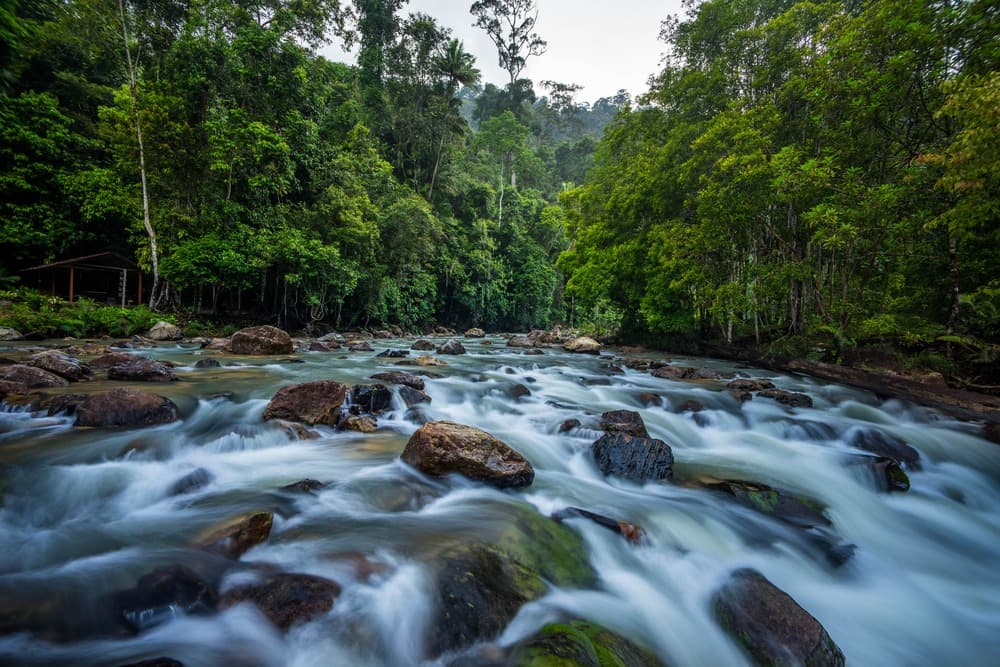
The park features over 26 km of marked trails, several remarkable waterfalls and river bathing spots. Hiking requires good physical fitness: uneven terrain, high humidity, and steep elevation changes on higher-altitude routes.
Wildlife
Endau-Rompin harbors a diversity of mammals rare in Southeast Asia. The felid family includes the Malayan tiger, Indochinese leopard, clouded leopard, Asian golden cat, leopard cat and marbled cat. Among large herbivores, the park welcomes Asian elephants, Malayan tapirs, barking deer, sambar, mouse-deer and greater mouse-deer. You'll also spot the bearded pig of Borneo, striped wild boar and Malayan sun bear. In the canopy roam long-tailed macaques, pig-tailed macaques, dusky leaf monkeys and banded langurs. The park also harbors an endemic amphibian species, the Gollum's frog (Ingerophrynus gollum).
Buaya Sangkut Waterfall
Standing 120 meters high, the waterfall takes its name—"trapped crocodile" in Malay—from a rock formation resembling a reptile immobilized on the cliff face. Access is via a demanding trail with sections reaching 60° incline. Allow several hours of hiking from the nearest camp.
Upeh Guling Waterfall
Millennia of water erosion carrying pebbles carved a circular hole in the rock, forming a natural bathing pool. The site serves as a swimming stop on the route to the upper waterfalls.
Tasik Air Biru
The "blue-water lake" bears a descriptive name: its crystal-clear waters reveal depths greater than appearances suggest. Swimming is possible but requires caution.
River tubing
Tubing along calm sections of the Endau and Jasin rivers remains the park's most popular water activity. Life jackets and helmets are provided by guides.
Practical information
The park has two main entrances: Kampung Peta, on the eastern boundary in Mersing district, and Selai, on the southwest boundary in Segamat district. Entrance fees remain modest, with additional charges for hiking permits and insurance. Hiring a local guide is mandatory for any overnight stay and for any hike to the waterfalls. No cellular network covers the park interior: inform those at home before entry and bring all necessary self-sufficient equipment (flashlight, medications, insect repellent, leech-proof socks).
Accommodation is rustic: camping at Pantai Burung, Kuala Jasin and Kuala Marong, dormitories and equipped chalets at Kampung Peta and Kuala Jasin. Dining options are limited to a canteen at the park headquarters at Kampung Peta; elsewhere, bring your own provisions and cooking equipment.
When to visit
The ideal season runs from April to October. The park closes during the monsoon, November to March, when trails become impassable and rivers dangerous. Late dry season, August-September, offers the best hiking conditions.
How to get there
To reach the Kampung Peta entrance, most accessible to international travelers, plan two stages from Kuala Lumpur or Johor Bahru. First reach the town of Kluang by train or bus, then continue by local bus or taxi to Kahang. The final section, on forest track, requires a four-wheel-drive vehicle: most travelers arrange this transfer through their agency or via operators based in Kahang. The total journey from Kuala Lumpur often exceeds a full day.
See also in the region
Malaysia hosts other complementary national parks if you extend your itinerary. On Borneo island, Bako National Park combines coastal forest, accessible wildlife and short trails, while Batang Ai National Park offers a more remote immersive experience. On the peninsula, Penang Hill provides a more accessible highland forest contrast, and cultural sites like Batu Caves near Kuala Lumpur help balance a nature-focused itinerary.
FAQ
Frequently asked questions
Three options: camping at Pantai Burung, Kuala Jasin or Kuala Marong, park dormitories at Kampung Peta, or equipped chalets available at Kampung Peta and Kuala Jasin.
A canteen at Kampung Peta headquarters serves simple Malaysian dishes. In other areas, you must cook your own meals with your provisions and equipment.
Yes. A local guide is mandatory for any overnight stay in the park and for any hike to the waterfalls.
Leech-proof socks, insect repellent, flashlight, first-aid kit and personal medications. Also bring quick-dry clothing and good hiking shoes.
No, the park has no signal. Inform those at home before entry and expect no communication during your stay.
Plan your trip
Endau-Rompin fits into a nature-focused circuit in peninsular Malaysia or as a complement to a Borneo stay. To build a custom itinerary including this park, consult our Malaysia travel suggestions.
Interested in this visit?
We can include it in your personalised itinerary.