Kek Lok Si Temple
Kek Lok Si Temple
Set on the hills of Air Itam, near George Town, one of Malaisie's largest Buddhist complexes: the Ban Po Thar pagoda, 10,000 Buddhas, and a Guanyin statue.
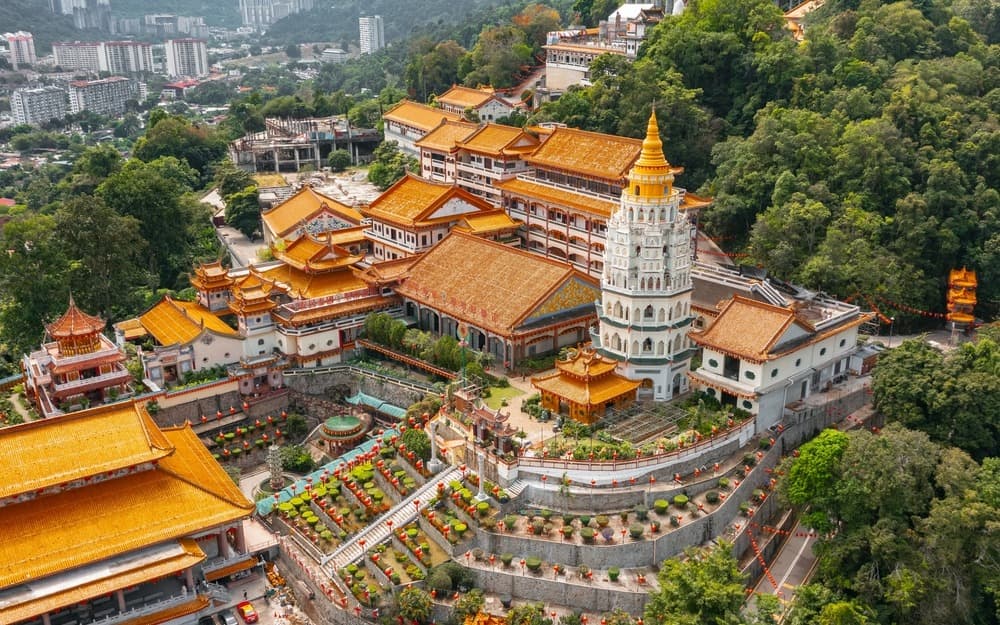
Kek Lok Si Temple, perched on the hills of Air Itam on the outskirts of George Town, is one of Malaisie's largest Buddhist complexes. This 12-hectare estate brings together the Ban Po Thar pagoda with its 10,000 Buddha statues, a bronze statue of Guanyin standing 30.2 meters tall, and several prayer halls that remain deeply active within Penang's Chinese community.
Why Visit Kek Lok Si Temple
The site holds three distinct appeals. First, architecturally: the Ban Po Thar pagoda, standing 30 meters high, combines a Chinese octagonal base, intermediate levels inspired by Thai design, and a Burmese crown—a rare condensation of the three great Buddhist traditions of Southeast Asia. Second, religiously: Mahayana Buddhism, Theravada Buddhism, and traditional Chinese rituals coexist here, making it a privileged vantage point for observing the diversity of devotional practices. Third, historically: founded in 1890, the temple was recognized as early as 1904 by Emperor Guangxu, and its expansion continued into the early 21st century.
History of the Temple
The temple's foundation began in 1890, initiated by Beow Lean, a Chan Buddhist monk who sought to provide Penang's Chinese community with a major religious center. Beow Lean had previously served in a monastery in Fujian, China, and drew on this monastic tradition to organize the site. The first construction phases were completed by 1905, made possible by the financial support of wealthy Chinese merchants in Penang, among them Cheong Fatt Tze.
By 1904, the temple's reputation had spread beyond local circles: Emperor Guangxu of the Qing dynasty invited Beow Lean to Beijing and presented him with sacred Buddhist texts, officially recognizing Kek Lok Si as a major religious institution for Penang's Chinese community. This episode reinforced the site's status within the Sino-Buddhist religious network of Southeast Asia.
The complex then expanded in successive phases. The great Guanyin statue was installed in 2002, and the pavilion housing it was completed in 2009.
What to See
The Ascent and the Pond of Liberation
Access is via a covered stairway lined with shops selling souvenirs, incense, and religious objects. It leads to the Pond of Liberation, home to numerous turtles, and opens onto the first prayer halls, adorned with wood and stone sculptures, engraved pillars, and colorful lanterns.
The Ban Po Thar Pagoda
The central structure of the site, the Ban Po Thar pagoda stands 30 meters high. Its uniqueness lies in the layering of three styles: a Chinese octagonal base, Thai intermediate levels, and a Burmese crown. Inside the pagoda and in neighboring sanctuaries, there are 10,000 Buddha statues in alabaster and bronze, accompanied by gilded representations of bodhisattvas and celestial kings.
The Guanyin Statue
To reach the upper part of the estate, inclined elevators spare you a long walk. They lead to the bronze statue of Guanyin, the Goddess of Mercy, standing 30.2 meters tall. She is surrounded by 100 smaller statues of the goddess and the 12 signs of the Chinese zodiac, beneath an open pavilion that offers an expansive view over Penang's hills.
Other Elements of the Complex
The Tower of Sacred Texts, the great hydraulic bell that rings regularly through the gardens, and the panoramic platform round out the visit. Plan for about 2 hours to explore the entire complex at a leisurely pace.
When to Visit
The temple welcomes visitors year-round. Two periods are particularly worth noting:
- Chinese New Year (typically late January to mid-February): the site plays a central role in the religious calendar of Penang's Chinese community. For roughly a month, tens of thousands of lanterns and lights illuminate the complex each evening. Crowds are substantial, but the atmosphere is unforgettable.
- The rest of the year: visitor numbers are more moderate. A morning visit allows you to avoid afternoon heat and the largest groups.
As for dress, plan to cover your shoulders and knees when entering the prayer halls.
How to Get There
The temple is located in Air Itam, on the outskirts of George Town. Several options allow you to reach it.
By Car or Via Ride-Sharing App
The simplest option is to use an app like Grab from George Town. Several drop-off points exist at different levels of the complex; choosing a drop-off higher up the hill reduces your walking distance.
By Public Bus
From Komtar bus station in George Town, lines 203 and 204 of the Rapid Penang network serve Air Itam and stop near the market. From there, you must walk to the lower entrance of the site, then ascend either on foot or by taking the inclined elevators built into the complex.
Practical Information
- Hours: the temple is open daily from morning until late afternoon. Verify exact hours before your visit, especially during festival periods.
- Admission: the main entrance is free. A modest fee applies for the inclined elevator and access to the pagoda.
- Duration of visit: 1.5 to 2.5 hours to explore the entire site.
- Dress code: shoulders and legs covered in the worship halls.
Nearby Attractions
The temple fits naturally into a broader itinerary around Penang and the Malaisie peninsula:
- George Town, a UNESCO World Heritage site, about twenty minutes by car: street art, colonial architecture, street food.
- Penang Hill, accessible from Air Itam, for a commanding view over the island.
- Batu Caves, near Kuala Lumpur, another major religious site to include in a Malaisie circuit.
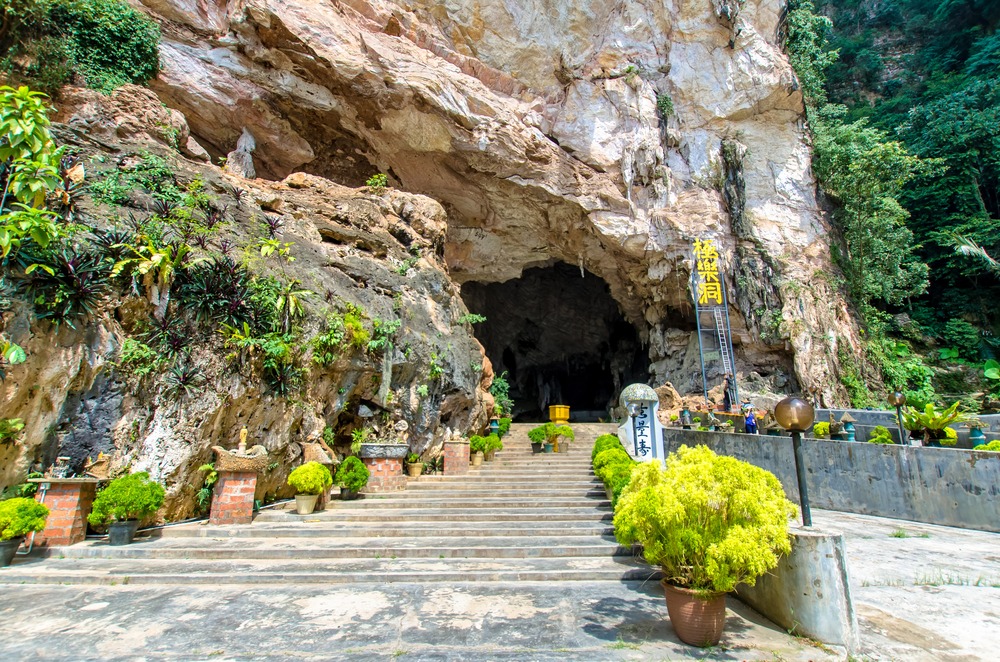
- Kek Lok Tong Temple, in the Ipoh region, worth visiting to compare a cave sanctuary with Kek Lok Si.
Frequently Asked Questions
Frequently asked questions
The temple is located in Air Itam, on the outskirts of George Town, on the island of Penang, Malaisie.
The main entrance is free. Modest fees apply for the inclined elevator leading to the Guanyin statue and for access to the Ban Po Thar pagoda.
Allow 1.5 to 2.5 hours to tour the entire 12-hectare estate, longer if you ascend to the Guanyin statue and spend time in the prayer halls.
Chinese New Year (late January to mid-February) offers spectacular illuminations but draws large crowds. The rest of the year, a morning visit lets you avoid afternoon heat and peak visitor numbers.
By ride-sharing app like Grab (simplest option, around 20 minutes) or by public bus from Komtar bus station: lines 203 and 204 of Rapid Penang serve Air Itam.
Include Kek Lok Si in Your Journey
Kek Lok Si Temple fits naturally into a Penang stay centered on George Town, or into a broader circuit combining Kuala Lumpur, Penang, and the east coast. To build a custom itinerary that includes this stop, explore our Malaisie travel experiences.
Nearby
Interested in this visit?
We can include it in your personalised itinerary.