Fort Cornwallis
Fort Cornwallis
Malaysia's largest standing colonial fort, Fort Cornwallis guards the north-eastern entrance to George Town with its 1799 chapel, cannons and 1882 lighthouse.
Located at the north-eastern tip of George Town, Penang, Fort Cornwallis is the largest colonial fort still standing in Malaisie. Built by the British East India Company in the late 18th century, it bears the name of Lieutenant-General Charles Cornwallis, Governor-General of Bengal at the time of its construction. The site combines star-shaped ramparts, period cannons, a chapel, a former powder magazine and a steel lighthouse dominating the north-eastern corner.
Why visit Fort Cornwallis
The fort offers a logical entry point to understand Penang's colonial history, from British occupation in 1786 through to George Town's development as a strategic port in the Strait of Malacca. Three main reasons justify a visit:
- Its status as the country's largest preserved colonial fort, classified as an ancient monument since 1977.
- A rare concentration of period buildings within the same perimeter: the 1799 chapel, the south-western bastion (Penang's oldest covered colonial-era building) and the 1882 lighthouse.
- Its position at the start of George Town's walking circuit, ideal for beginning exploration of this UNESCO World Heritage city.
History
Fort Cornwallis's history begins in 1786, when Captain Francis Light took possession of Penang Island from the Sultan of Kedah. He then erected a rudimentary fort, made of nibong palm trunks, to protect the new colony against pirates and threats from Kedah.
After the outbreak of the Napoleonic Wars in 1804, the fort was completely rebuilt in stone and brick. Work was completed in 1810, at a total cost of 80,000 dollars. A moat 9 metres wide and 2 metres deep then surrounded the fortress; it would be filled in during the 1920s due to a malaria epidemic.
Despite its initial military purpose, Fort Cornwallis primarily served administrative functions throughout its history. It was never attacked. Official protection dates from 8 September 1977, when it was classified as an ancient monument and historical site under Malaisie's Antiquities Act.
What to see on site
The chapel
Built in 1799, it bears witness to the religious life of the early settlers. This building hosted Penang's first colonial wedding, uniting John Timmers to Martina Rozells, widow of Captain Light.
The south-western bastion
Often confused with the chapel, this building was the site's main powder magazine. Its massive roof and surrounding buttresses correspond to the typical characteristics of ammunition depots of the era. It is Penang's oldest covered building from the colonial period.
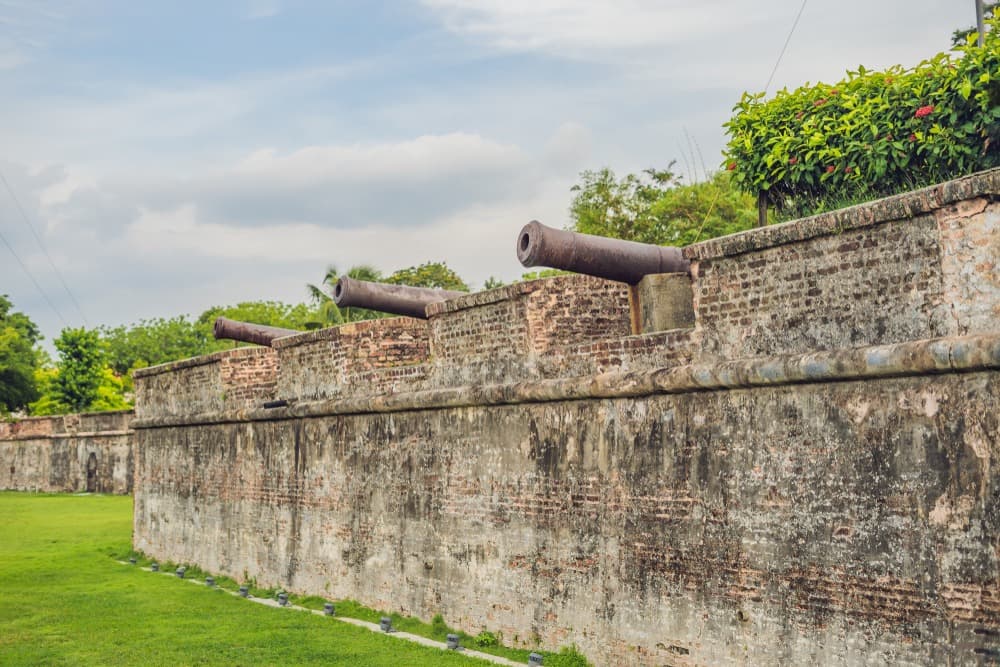
The cannons and ramparts
Several historical cannons punctuate the fort's perimeter, including the famous Seri Rambai. The ramparts trace a star-shaped plan typical of 19th-century colonial fortifications.
The lighthouse
A 21-metre steel lighthouse, erected in 1882, stands in the north-eastern corner. It is Malaisie's second-oldest lighthouse, after Cape Rachado at Tanjung Tuan (Malacca). Initially named Fort Point Lighthouse, it became known as Penang Harbour Lighthouse after renovations in 1914 and 1925. It is the only lighthouse in Malaisie to resemble a ship's mast, and the only one on the peninsula with no navigational function.
The restaurant and terrace
A restaurant occupies part of the site, with a terrace overlooking the Strait of Malacca. On weekends, temporary food and beverage stalls enliven the grounds, attracting both residents and visitors.
Practical information
- Access: on foot from George Town's historic centre. The main entrance is on Jalan Tun Syed Sheh Barakbah, near Penang's town hall.
- Visit duration: allow 1 to 2 hours to tour the site, buildings and rampart walkway.
- Fees: paid entry, with reduced rates for Malaisie residents. Payment conditions (card or cash) vary; it's best to bring both.
- Opening hours: open daily during the day, generally until early evening. Check current opening hours before your visit.
- Guided tours: available on certain weekend days, at several time slots throughout the day.
When to go
Penang enjoys a tropical hot and humid climate year-round, with stable temperatures around 27-32°C. The driest season generally runs from December to March, while the year-end monsoon (October-November) brings brief but intense showers. For a fort visit, prefer morning or late afternoon: shade is rare on the ramparts and midday heat can be oppressive.
Nearby
Fort Cornwallis is part of George Town's walking circuit, a UNESCO World Heritage site. Several other sites in Malaisie complement a discovery of the country:
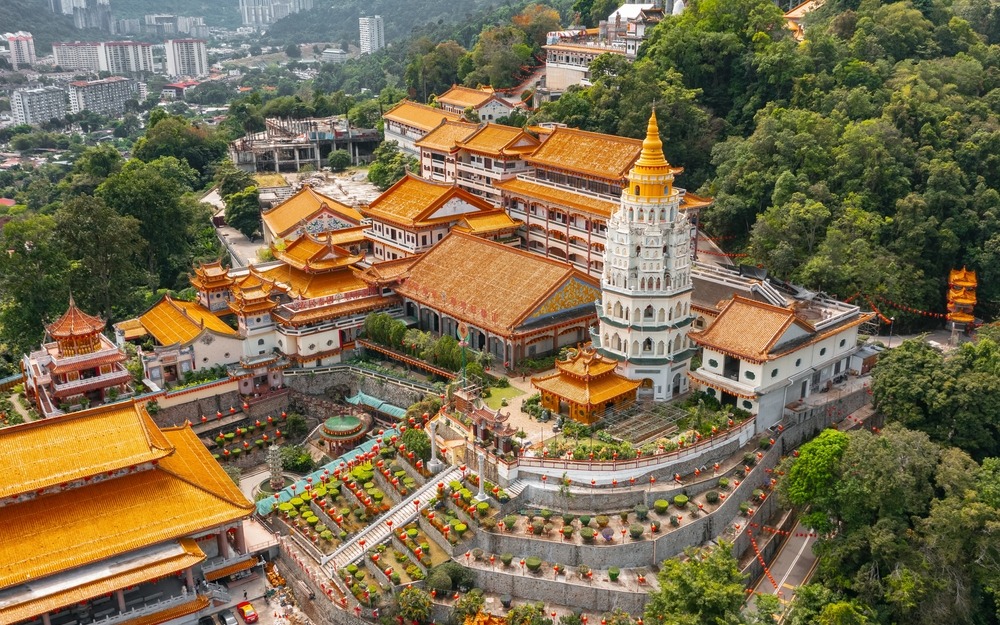
- Kek Lok Si temple, Malaisie's largest Buddhist temple, about twenty minutes' drive away.
- Kek Lok Tong temple, a troglodyte sanctuary in Ipoh, accessible during a wider excursion through the peninsula.
- Batu Caves, near Kuala Lumpur, often visited alongside a Penang stay.
- Bako National Park, in Borneo, to extend your journey into a natural setting.
Frequently asked questions
Frequently asked questions
Plan on average 1 to 2 hours to tour the grounds, view the cannons, visit the chapel, the south-western bastion and walk the ramparts. A guided tour may extend this slightly.
Yes, especially for travellers interested in colonial history and military architecture. It is Malaisie's largest preserved colonial fort and a logical starting point for George Town's historic circuit.
The fort is located at the north-eastern tip of George Town, near Penang's town hall. The main entrance is on Jalan Tun Syed Sheh Barakbah. It is easily accessible on foot from the historic centre.
Include Fort Cornwallis in your trip
The fort naturally fits into an itinerary combining Penang, Kuala Lumpur and the west coast. To build a tailor-made stay incorporating George Town and the country's other highlights, see our trips to Malaisie.
Nearby
Interested in this visit?
We can include it in your personalised itinerary.