Driving in Malaysia: License, Traffic Rules and Road Conditions
Malaysia is a destination where renting a car is worth considering, provided you're ready for a significant shift in driving conventions. For a driver accustomed to driving on the right, switching to left-hand traffic requires genuine adaptation, especially in cities. But once you've made that adjustment, the road network, one of the most developed in Southeast Asia, more than rewards the effort.
Malaysia is a destination where renting a car is worth considering, provided you're ready for a significant shift in driving conventions. For a driver accustomed to driving on the right, switching to left-hand traffic requires genuine adaptation, especially in cities. But once you've made that adjustment, the road network, one of the most developed in Southeast Asia, more than rewards the effort.
Driving is also the best way to venture off the beaten path. From the misty heights of the Cameron Highlands to the beaches of Langkawi, passing through the temples of Penang, a car opens doors that buses and taxis don't always reach. Yet you must understand the rules of the road.
1. Driving License
To legally drive in Malaysia during your stay, you'll need two mandatory documents:
- Your national driving license (valid)
- Your International Driving Permit (IDP), obtained before departure
These two documents are inseparable. One without the other is insufficient.
There is, however, an alternative solution, tolerated by local authorities but not officially recognized. It involves having your license translated into English by a translator accredited by the French embassy, then having it legalized by that same embassy. This option works in practice, but it's better not to rely on it as your sole recourse.
Important note: In Malaysia, a car license and a motorcycle license are two distinct things. If you only hold a car license, you won't be permitted to ride a scooter or motorcycle. Only a motorcycle license authorizes this.
2. Documents, Age and Insurance
Who Can Rent a Car?
Here are the conditions generally required by rental agencies:
- Be at least 23 years old (some agencies accept from 21, with a surcharge of 6 to 10 euros per day)
- Hold a valid license for at least one year
- Present a valid passport
- Have a credit card for the security deposit
The maximum age is generally set at 70 years.
Car Insurance
Every vehicle driving in Malaysia must be covered by third-party liability insurance, mandatory by law. It's included in the rental, but covers only damage caused to third parties.
To be truly protected, it's advisable to take out supplementary coverage (theft, vehicle damage). Read the contract carefully before signing: deductibles can be substantial without extended coverage.
Documents to Keep on You at All Times
These documents must accompany you on every trip:
- Your national driving license
- Your international driving permit
- Your passport
- Your rental contract
- Your valid insurance certificate
3. Main Traffic Rules
Left-Hand Traffic
This is often the first surprise when arriving in Malaysia. The country follows the British model: left-hand driving, steering wheel on the right, and overtaking on the right. Roundabouts are navigated counterclockwise.
If you've never driven on the left before, absolutely rent an automatic car. Also avoid rush hours in cities for your first kilometers, and prefer less-traveled roads as you adjust.
Speed Limits
Maximum speeds vary by environment: 50 to 60 km/h in built-up areas, 80 km/h on national roads, and up to 110 km/h on motorways.
On three-lane motorways, the left lane is the slow lane, the right lane is the fast lane. If you're maintaining a steady speed without overtaking, stay in the center lane.
Note: Fixed speed cameras are present throughout the network. There's very little tolerance.
Phone, Alcohol, Seatbelts, Lights... The Basic Rules
Certain rules apply without question:
- Seatbelts mandatory for all occupants, including those in the rear
- Child car seat required for children under 8 years old
- Phone use at the wheel prohibited, except with a hands-free device. Fine of approximately 208 euros for violation
- Legal blood alcohol limit set at 0.08%. Checks are frequent, fines start at 417 euros, and prison sentences can reach fifteen years in serious cases
- Dipped headlights mandatory between 19:00 and 07:00
- Smoking in a car in the presence of minors prohibited
Road Signs
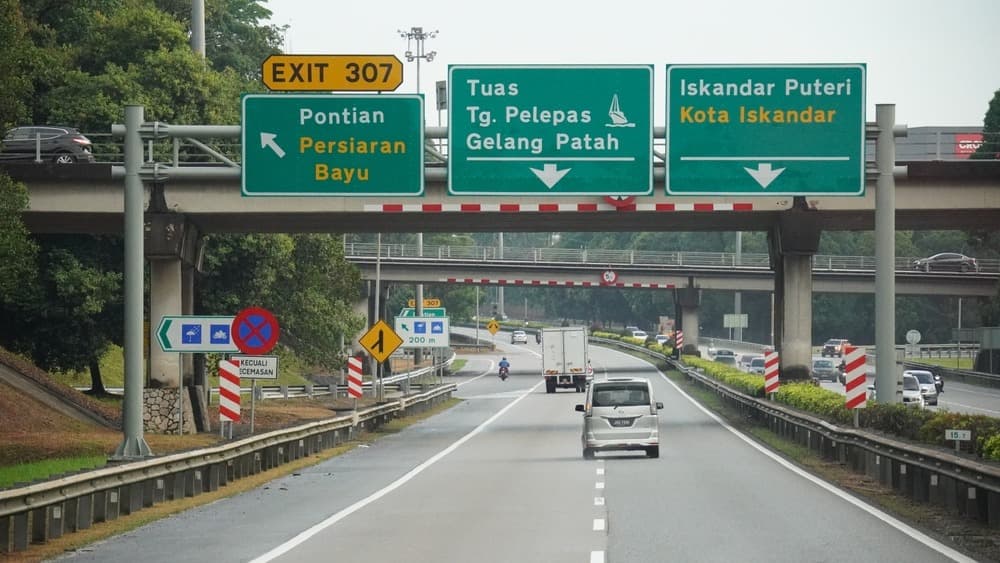
While Malay is the dominant language on signs, international pictograms cover most common situations. Near tourist areas, airports and train stations, English provides additional support.
A few words appear regularly and are worth memorizing before taking to the road:
- Berhenti (stop)
- Awas (danger)
- Dilarang Masuk (no entry)
- Sekolah (school)
- Had Laju (speed limit)
- Laluan Kanan (right lane)
When faced with an incomprehensible sign, a camera translation app will resolve any doubt in seconds.
4. Tolls, Fuel and Parking
Tolls
Malaysian motorways are generally toll roads. The system operates with fixed-rate barriers or per-passage, depending on the sections. Rates vary based on distance and vehicle type.
Some examples of costs for a one-way journey:
- Kuala Lumpur – Melaka: approximately 1.50 to 2.10 euros
- Kuala Lumpur – Penang: approximately 6.25 euros
- Kuala Lumpur – Johor Bahru: approximately 7.30 euros
The most common payment method is the Touch 'n Go card, rechargeable at petrol stations, convenience stores and ATMs. A SmartTAG device or RFID sticker also allows toll-free passage. If you're renting a car, check what device is provided and ensure the balance is sufficient.
Tip: Keep a minimum of around 4 euros on your Touch 'n Go card to avoid any unexpected blockage at a toll booth.
Fuel
Petrol stations are well distributed throughout the country. Three main fuel types are available:
- RON95: the most common and least expensive (approximately 0.42 euro/liter). It's subsidized for Malaysians; tourists pay market price.
- RON97: premium fuel (approximately 0.73 euro/liter)
- Euro 5 Diesel: for SUVs and heavier vehicles (approximately 0.45 euro/liter)
Before venturing into rural areas like Taman Negara or the East Coast, fill up. Stations are scarce in certain remote regions.
Parking
In cities, parking operates with a color-coded system painted on the ground:
- White lines: parking allowed (free or paid)
- Single yellow lines: forbidden at certain times
- Double yellow lines: permanently forbidden
- Blue lines: paid parking
Payment is via parking meter or, increasingly, via mobile app. In Kuala Lumpur, Selangor and Putrajaya, the Flexi Parking app is the standard. Rates are reasonable: between 0.13 and 0.41 euro per hour on the surface, more in underground parking.
Tip: Many shopping centers offer the first hours free if you have your ticket validated at the cashier or with a purchase.
5. Road Conditions and Driving Safety in Malaysia
A Generally Well-Maintained Network
Malaysia has a road network that ranks among the most developed in Southeast Asia, but road quality varies considerably by region.
The 800-km North-South Expressway crosses the peninsula from the Thai border to Singapore. The main routes to Kuala Lumpur, Penang and Johor Bahru are modern and well-maintained.
Outside the major routes, the situation changes. In the Cameron Highlands, around Taman Negara or on the East Coast, roads can be narrow, winding, poorly lit and sometimes flooded after heavy rain. An SUV is better suited than a city car.
Blending Into Malaysian Traffic
Outside motorways, city driving can be surprising. Motorcyclists are everywhere: weaving between lanes, overtaking without warning and not always signaling direction changes.
The golden rule: maintain your distance, stay calm and never assume the driver ahead of you will behave predictably.
A Few Common-Sense Precautions
On the road as when stationary, these few reflexes prevent many uncomfortable situations:
- At traffic lights, leave space in front of you.
- Keep doors locked and windows closed when driving in the city.
- Never leave valuables visible in the passenger compartment.
- Avoid picking up hitchhikers. It's not a local practice.
- Outside cities, don't stop if a stranger signals a problem with your car or hits you from behind. Head first to a safe zone or police station.
In Case of Accident
Dial 999 for police or emergency services. If no one is injured, move the vehicle out of traffic. Exchange information with the other driver (name, address, registration number, insurance) without trying to determine fault on the spot. Take photos of the scene.
If your car breaks down on a fast lane, turn on hazard lights, lock the doors and wait for police. If someone offers help, ask them to call the authorities. If possible, move the vehicle out of traffic.